Experience, the son of hard mistakes A robot moves through an orchard slower than a person walks, and its navigation suddenly reports that it's racing along at 180 km/h. That's how the onboard DLIO localization system behaved on the VETER TEGU. A localization system calculates the machine's position from sensor data. DLIO works as a satellite-free onboard navigation system: the lidar scans the surroundings with a laser, a motion sensor picks up turns and jolts, and the software compares each new scan with the previous one to work out how far the robot has moved. If that comparison goes wrong even once, the error carries forward. FAST-LIO2 solves the same problem with the same set of sensors. What the machine saw. In the field recordings, with DLIO running live, the speed it reported would jump after a few minutes of driving - from a slow crawl to noticeably faster in a single step - and then within a few seconds climb to 180 km/h. The position drifted along with this imaginary speed, and the recorded route ballooned into tens of kilometers. How the cause was found. VETER ROBOTICS engineers replayed the same field-day recording on the onboard hardware through a different system, FAST-LIO2. The route measured by RTK satellite positioning was 332.4 m. FAST-LIO2 disagreed with it by only a few percent, while DLIO came up with 20,653 m. Same input data, different result. So the cause had to be in the position calculation itself. A caveat: this was a replayed recording. FAST-LIO2 was not driving the machine. These tests took place back in May. DLIO is only one of the localization loops in VETER ROBOTICS robots, and this analysis concerns it alone. At VETER ROBOTICS the systems are constantly being improved, and every update is run on test benches first.
You would think a ground robot's worst enemies are stairs, mud and a dead battery. In practice, what stops an inspection machine at an industrial site most often is an ordinary closed door. That story and the rest of the week's news - in our roundup of the ground robotics industry. According to The Robot Report, ANYbotics, together with dormakaba and LEGIC, has taught the four-legged ANYmal robot to pass through doors that open only with an electronic access badge. Doors like these stand at power plants, in chemical plants and at mines - you don't get in without a badge. Now the robot gets access like an employee: the door opens for it under the same rules and with the same entry in the log, and the building needs no modifications. The solution was tested at an operating facility, and it can now be added to any ANYmal machine already in service. The point is simple: an equipment inspection round only counts if the machine reaches every unit, and a closed door was the final barrier. The second story comes from the labs. Tech Xplore Robotics writes that engineers at UCLA and the University of Michigan have built an experimental frog-like robot on elastic rods that bend and twist. Across six different types of terrain, this design proved faster than traditional rigid legs. Farm use is still a long way off - this is locomotion research. But the direction is intriguing: softness instead of rigidity could come in handy where rigid legs slip, for example on loose, uneven ground. The week's third topic is reliability. The Robot Report is announcing a panel discussion by engineers from WiBotic, Burro and Nextpower at an industry conference: they will dig into why outdoor robots break down. The causes are familiar to anyone who runs equipment: temperature swings, water, dust-clogged connectors, vibration. A machine that drives beautifully around a lab fails in completely different ways outdoors. And fourth - tools for developers. On the ROS Discourse forum, where robot builders talk shop, Mission Canvas was presented: a program in which a machine's individual skills are assembled into a coherent route - where to go, what to do there and where to head next. It's a tool for the people who configure robots; a machine's owner doesn't need it directly, but it's tools like these that will one day let a robot do all this on its own. Where does VETER ROBOTICS fit in? The VETER TEGU tracked platform hauls the raspberry harvest along the rows of a berry farm - the same hauling along a known route that foreign field machines do. And the VETER SCINK tracked platform with a snow blower attachment works as a snow removal robot: it clears snow on roads and walkways.
You would think the faster a machine goes, the more energy it burns per kilometer. A test on the VETER TEGU tracked platform showed that's almost true, but the difference is smaller than you'd expect: at a steady pace from 1.4 to 3.3 km/h, consumption per kilometer rises with speed by about 10%, and above 4 km/h we have no data yet - that measurement is still to come. A turn at the end of the row, on the other hand, costs about four times as much as driving straight. The tracked chassis carries an onboard data logger - a device that automatically records current and speed while the machine works. It logged 4 days of a ground robot working in an orchard: about 3.6 hours of driving, unloaded, on gentle orchard slopes of up to 5 degrees. Only the motor current went into the measurement. The onboard electronics aren't included, even though they run all the time, even when parked, and draw an estimated 39 W - roughly like a small light bulb. So the real battery drain is slightly higher than the figures below - by that same light bulb. Most of the work happened driving straight at about 2.3 km/h - slower than a person's normal walking pace. Two things are worth distinguishing here: power is how much energy the motors are pulling right now, while consumption is how much will be spent per kilometer of travel. Driving straight at about 2.3 km/h, consumption is 1.9 Ah per kilometer. At a steady pace on level ground, consumption per kilometer rises with speed: 1.8 Ah per kilometer at 1.4 km/h and 2.0 Ah per kilometer at 3.3 km/h - a difference of about 10%. Above 4 km/h we have almost no data, so there are no conclusions yet - that measurement is still to come. What this means for a farm: the robot's speed determines how fast the battery drains over time, while consumption per kilometer of row barely changes. Covering the same row at 3.3 km/h instead of 1.4 km/h means spending about 10% more per kilometer, but in noticeably less time. A turn is a different story. The machine turns slowly, at about 1.6 km/h, but the motors pull noticeably more than they do driving straight. If you convert a turn into a kilometer of that kind of movement, you get 7.8 Ah per kilometer at about 1.6 km/h - roughly four times a kilometer of straight driving. The conclusion VETER ROBOTICS engineers give orchard owners is simple: the longer the rows and the fewer turns on the route, the farther the machine will go on a single charge. One nice detail to finish with: when the machine stands still, motor current is zero and measured power is 0 W - only the electronics are running, with their calculated 39 W. A pause in the work costs almost nothing. And over all 4 days the motors never heated above 41 degrees - warmer than a human hand, but a long way from overheating.
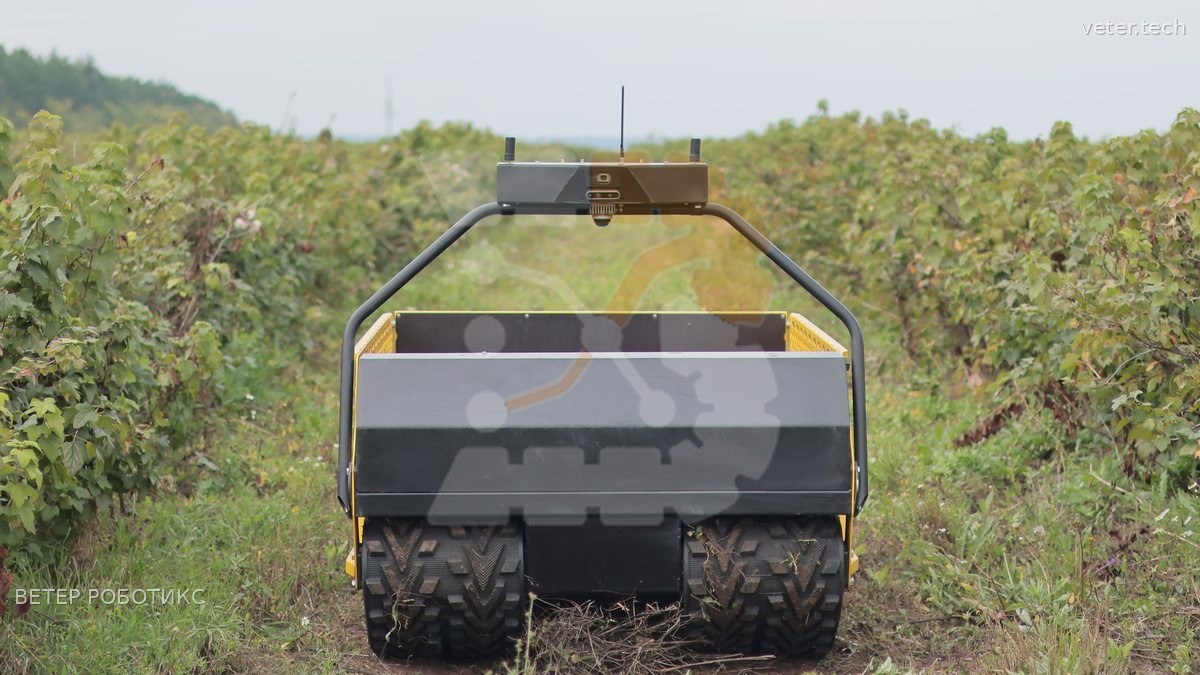
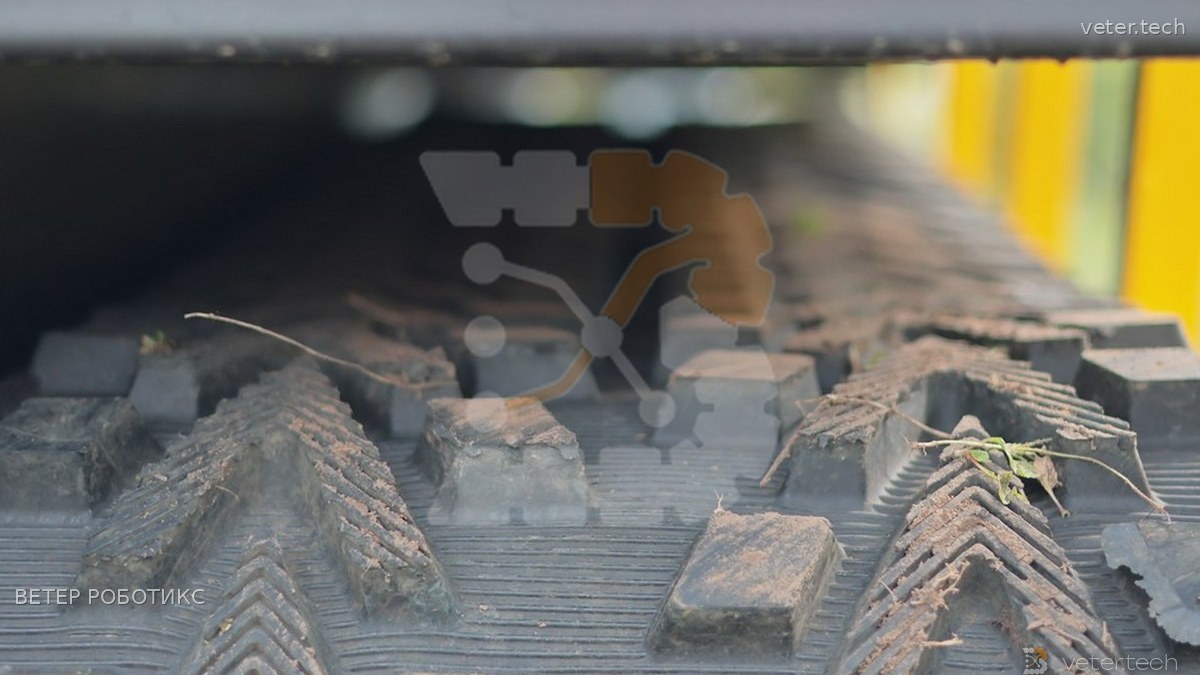
A wheel rests on the ground in a small patch; a track rests on it along its whole length. It's the same as the difference between a heel and skis: on skis a person walks across snow, on heels they sink in. A machine works the same way - the weight is the same, but the pressure on the ground is completely different. Why it matters. The harder a machine presses on the soil, the more it compacts it and the deeper the rut it leaves. Compacted soil doesn't absorb water as well and lets less air through to the roots. That is exactly why GOST 26955-86 sets limits: for agricultural machinery the maximum allowable pressure runs from 80 kPa in spring on wet ground to 210 kPa in summer on dry ground. To get a sense of the scale: a person weighing 75 kg, standing in shoes, exerts about 15 kPa, and while walking, when all the weight is on one foot, about 30 kPa. So even the strictest limit for machinery is several times higher than what a person exerts walking on the ground. The tracks on our machines are 400 mm wide, and two of them give a contact area of 1.64 m² - noticeably more than the footprint of a standing person. The ground pressure works out to 3.5 kPa - several times lower than the allowable limit for agricultural machinery, and lower than a person standing in boots. And the less pressure a machine puts on the soil, the less it compacts it and the shallower the rut it leaves. Second, tracks give you off-road capability. On tracks the robot gets through snow and mud where a wheeled machine spins its wheels or gets stuck. A tracked platform can turn in place: it needs no turning radius, it pivots on the spot the way a person does standing still. It climbs up to 30 degrees on dry ground - a slope you would walk up with effort, and the machine takes it. The third is stability. Support along the full length of the track keeps the machine level on uneven ground, in snow ruts and on loose soil. For a ground robot that works without a driver this matters: it has to follow its route just as confidently in the morning over fresh snow as at midday on a soaked path. How we build it. We design the frame, the tracks and the drives ourselves. The dimensions and the tractive effort - the reserve of pulling power that lets the machine haul heavy attachments without getting stuck - are calculated for real-world jobs.
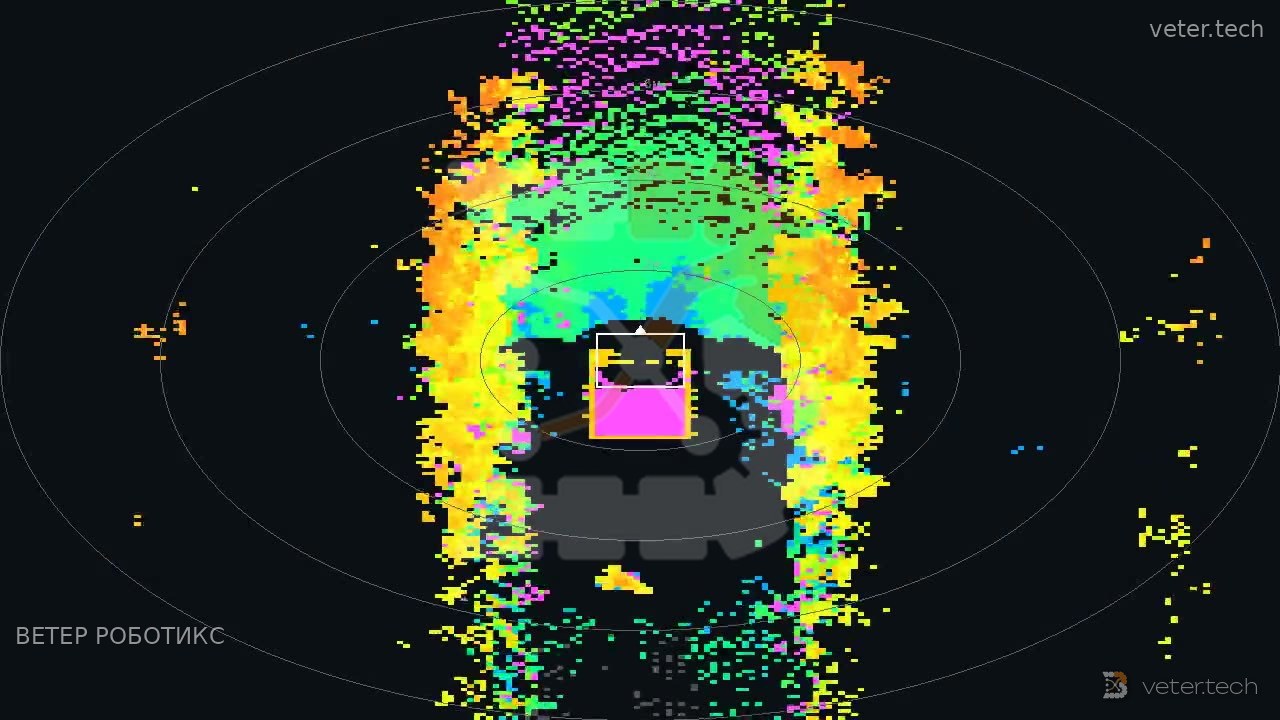
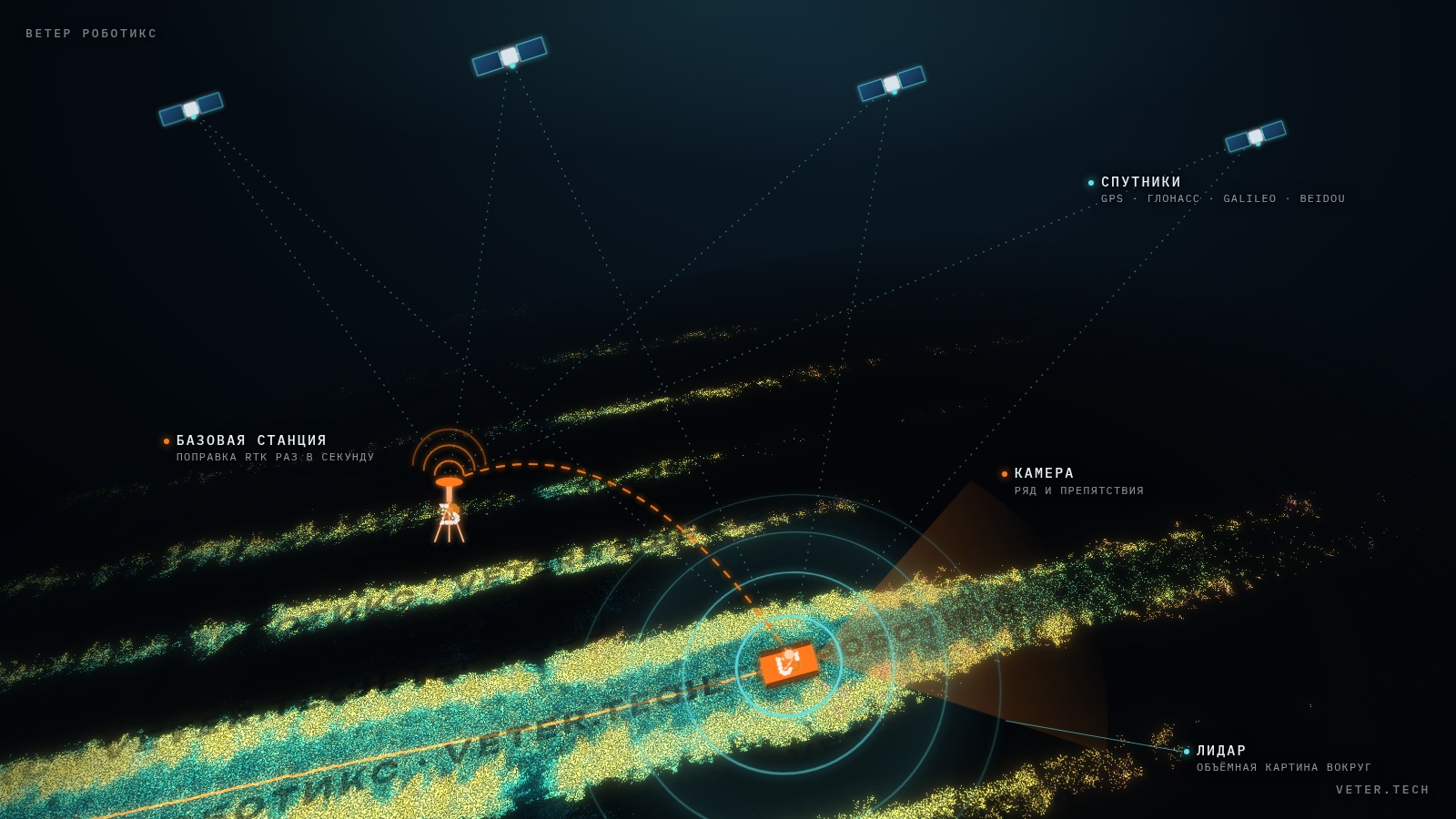
The GPS in your phone is off by several meters. On the road that's good enough: the street is wide, and a voice tells you when to turn. A robot in an orchard can't get away with that. Rows of berry bushes are about three and a half meters apart, and a two-meter error puts a track on top of a bush. So our robot works out its position three ways at once: by satellite, by lidar and by camera. How GPS works. Every navigation satellite continuously broadcasts the time from its own extremely precise clock. A receiver on the ground picks up the signal and works out from the delay how far away the satellite is. Knowing the distance to several satellites, it can fix its own position. It's a bit like working out where you are standing from how late the chimes of three different bell towers reach you. Several satellite navigation systems are in orbit today - GPS, GLONASS, Galileo and BeiDou - and our robot's receiver sees about forty satellites at a time. Where the meters of error come from. The signal travels down through the atmosphere, and the upper layers delay it, sometimes more and sometimes less, depending on the weather and the time of day. The clock in the receiver isn't perfect either. Each small effect adds centimeters to the measured distance, and together they add up to meters. How RTK removes the error. A fixed base station stands nearby, its position surveyed very precisely in advance. It watches the same satellites through the same atmosphere and sees almost exactly the same error as the robot. The gap between what the station calculates and where it actually stands is the correction. Every second the station sends that correction over the mobile network; the robot subtracts it from its own calculation and knows where it is to within a couple of centimeters. The method is called RTK. Why the robot needs lidar and a camera. Satellites tell the robot where it is on the map, but not what is around it. Under tree canopy and next to buildings the signal weakens or bounces, and over a summer a bush can grow out into the row. Lidar is a laser rangefinder: many times a second it sweeps everything around it and builds a 3D picture of where the row is, where a post is, where a person is. The camera adds what lidar can't make out. Together they keep the robot centered between the rows and stop it short of an obstacle, while the satellites make sure it sticks to its route and, at the end of a row, turns into the right one next. Satellite precision like this has been at work in fields for years. Guidance systems and tractor autosteer run machinery in straight parallel passes with no skips or overlaps; precision agriculture is built on it. The difference is that the tractor still needs a person in the cab. What we do. VETER Robotics machines drive by satellite navigation with RTK corrections, while lidar and a camera guide them down the row and watch for obstacles. That is how our robot runs a route on a berry farm by itself: it drives a row about five hundred meters long, turns around and enters the next one. The image shows a real point cloud captured by our robot's lidar among the berry rows, along with a diagram of how the satellites, the base station, the lidar and the camera work together.
Ground robots have moved off the test site and into daily work. Here are five areas where tracked and wheeled machines already do jobs people used to do, with places and numbers from 2026. Sidewalk delivery. In Leeds and Sheffield, six-wheeled robots deliver food ordered through an app. The operator reports about 3,000 machines in more than 270 towns and cities; a typical delivery takes up to 30 minutes over a distance of up to three kilometers. In 2026 the service is expanding into other European markets. Field work. Two field machines were unveiled in California in February. The first is a laser weeder: cameras find the weed and a laser kills it with no herbicide, for claimed savings of up to 80% on weed control. The second is a kit that turns an ordinary tractor into a driverless one: the machine follows its route by itself, and the operator can take over at any moment. In effect, a robotic platform takes on the work a compact tractor does on a small farm. Quarries and mines. This is where the largest autonomous fleets are. In August 2026 the first batch of fully electric autonomous haul trucks shipped to South America. Another manufacturer shipped more than 1,900 autonomous haul trucks in the first half of 2026; they work at nearly 40 mines, seven of which run fleets of more than 100 machines, and the largest fleet numbers 220. The robots haul rock, push spoil on the dumps, load coal and feed it to the crusher. One manufacturer's autonomous trucks have logged more than 13 million km and moved more than 41 million cubic meters of rock. Grounds maintenance. In September 2026, professional mowers for parks, campuses and large properties were introduced in Berlin. In the UK, robotic mowing is used by contractors, municipalities and property managers; solar farms are a niche of their own, with grass cut between the rows of panels. The machines hold their route by satellite, lidar and cameras to within centimeters, with no boundary wire around the perimeter. Working areas run from 8,000 to 28,000 square meters. In winter the same grounds are covered by a snow-removal robot: a tracked chassis with attachments clears the roads and paths. Security and inspection. Near Melbourne, a four-legged robot walks the rounds at a plant and an industrial park. One machine covers two jobs: perimeter security, with intruder recognition and camera tracking, and equipment inspection, where photos are taken from the same spots every time so that frames can be compared from one round to the next. Recognition runs on board, so the round continues if the network goes down. In Taiwan, similar machines were shown in June for patrolling coastlines and islands. What all these areas have in common. The work comes down to three things: carrying cargo along a known route, making regular rounds of a site, and observing with a record. It is monotonous, it is long, and it is done in conditions that are hard or dangerous for people. What we do. VETER Robotics has work of its own in four of these five areas. The VETER TEGU tracked platform hauls the raspberry harvest along the rows of a berry farm - the same known-route transport as in field work abroad. For orchards we are training the Smotritel neural network, which analyzes footage from the robot's camera and separates crop from weed. The VETER SCINK tracked platform clears snow with a snow-removal attachment. The VETER AGAMA patrol robot for perimeter security is in development; for it we are building a detector that tells a person from an animal and spots a fire starting. A project in its own right is SARA OS, our operating system for ground robots: it controls the drives, interprets the surroundings and keeps the link to the operator's tablet. Some of the figures from abroad come from manufacturers' own statements and have not been independently verified.
We are working on a product to help farmers. Smotritel (Russian for "caretaker") is computer vision for our tracked robotic platform: it analyzes footage from the camera of a robot driving down a row and separates crop from weed. Right now the neural network tells three things apart: currants, raspberries and weeds. On video this shows up as glowing, labeled regions and a table of each one's share of the frame. We train the system on our own recordings. The training segments are labeled by someone who knows this field, reviewing the runs and marking, frame by frame, what to use. AI in agriculture starts with labeling, and the quality of the labels decides everything. Measurements from a currant row, the August 20 run, 351 frames: currants take up 26% of the frame, weeds 50%. Averaged over the segment, crop is 30% and weeds 47%. In the open space between rows, crop is 1.6% and weeds 75.7% - where there is no bush, the model doesn't find one. Why a farmer needs this. A robot that can tell a bush from a weed can work selectively: it treats the space between the rows and leaves the crop alone. The same vision will serve our other applications too - robotic land clearing and roadside maintenance - where overgrowth has to be told apart from plantings in exactly the same way. Limitations. These are first steps. For now the analysis runs on recordings on a test bench; putting an autonomous platform with this vision into the field comes next. In frames with little crop in them, the model sometimes labels as raspberry something that isn't: 4% of windows in one of the segments. Raspberries have so far been labeled from a single run, and that is the model's main weakness with them. The work continues.
We are teaching a neural network to see an orchard the way an agronomist does. The project is called Smotritel (Russian for "caretaker"). In footage from the robots' cameras, the algorithm reliably recognizes currant bushes and tells them apart from raspberries, grapevines and other shrubs. Next, Smotritel will learn to notice weeds in the row, find ripe and unripe berries, identify diseases from the leaves and pick out weak bushes. A robot with vision like this assesses the state of the orchard and tells the farmer which block needs attention. The system is designed for Russian farms growing berry crops: currants, raspberries, blueberries and gooseberries. It is trained on the robots' field recordings and on open data, and it gets more accurate with every season. The goal is a dependable digital assistant for every farmer.
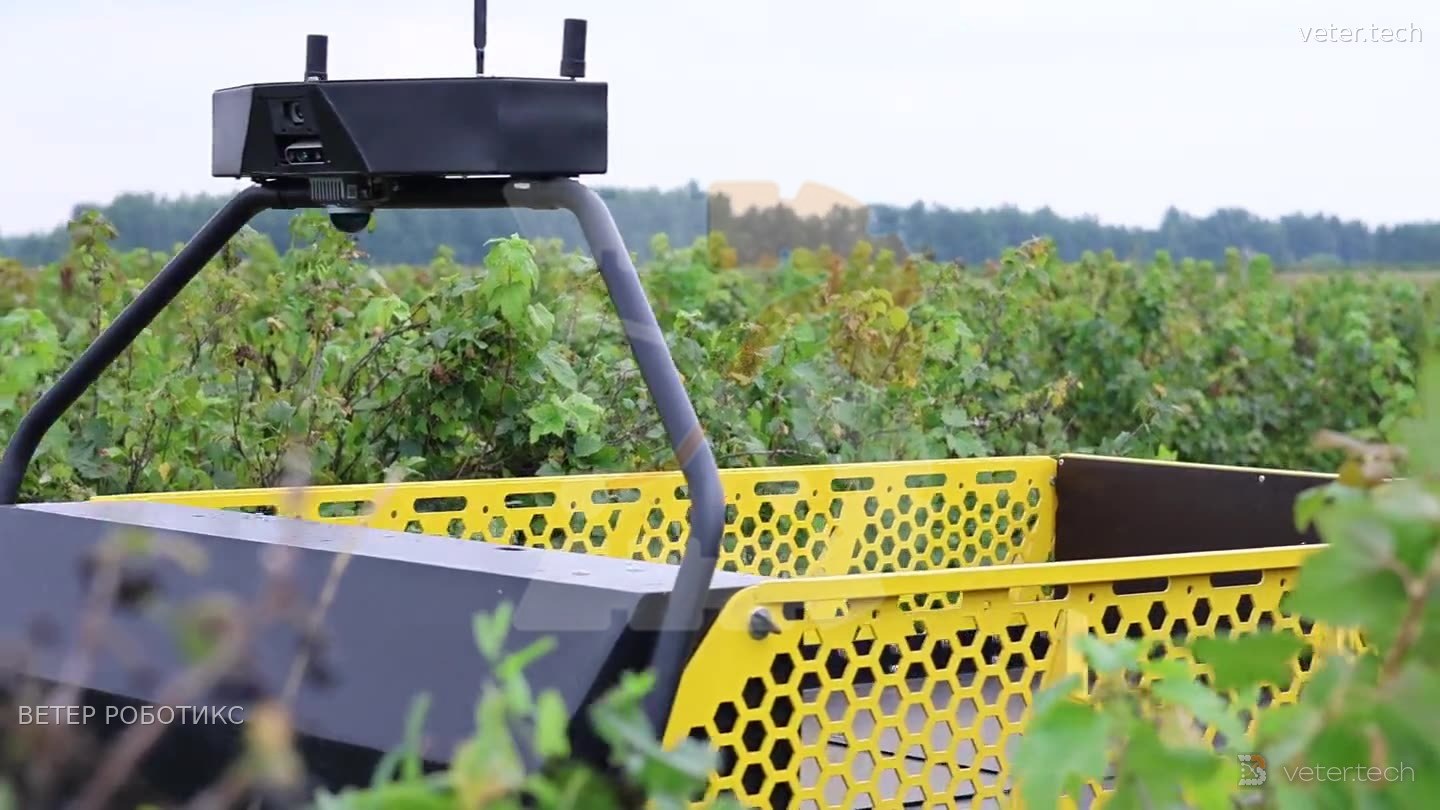
VETER TEGU, the autonomous tracked robot from VETER Robotics, is hauling freshly picked raspberries. The machine drives through the plantation by itself using AI: lidar lets it navigate by the bushes, with no need for a satellite signal. The heavy crates ride in the dump bed. The smooth ride protects the delicate fruit, and the robot goes easy on the soil.
SARA OS is our own operating system for ground robots. It controls the drives, interprets the surroundings, and handles autonomy and the link to the operator's tablet.
We are getting the third machine in our lineup ready for release. The robot will patrol the perimeter of industrial sites and farms on a schedule and log the results of every patrol.
An interactive site map, jobs assigned right on the map, route and stop monitoring. We've brought manual control and supervision of autonomous work together in one interface.
CONTACT
Tell us what you need done
Describe the job and the conditions, and we'll tell you whether a standard machine will handle it or it calls for custom work.


 Telegram
 MAX